| |
PREVALENCE AND SEVERITY OF STEATOTIC LIVER DISEASE IN WOMEN WITH AND WITHOUT HIV
|
| |
| |
JAIDS September 04, 2026
Download the PDF
Download the PDF
The most notable findings in this study center on the relationship between HIV, SLD, and fibrosis.
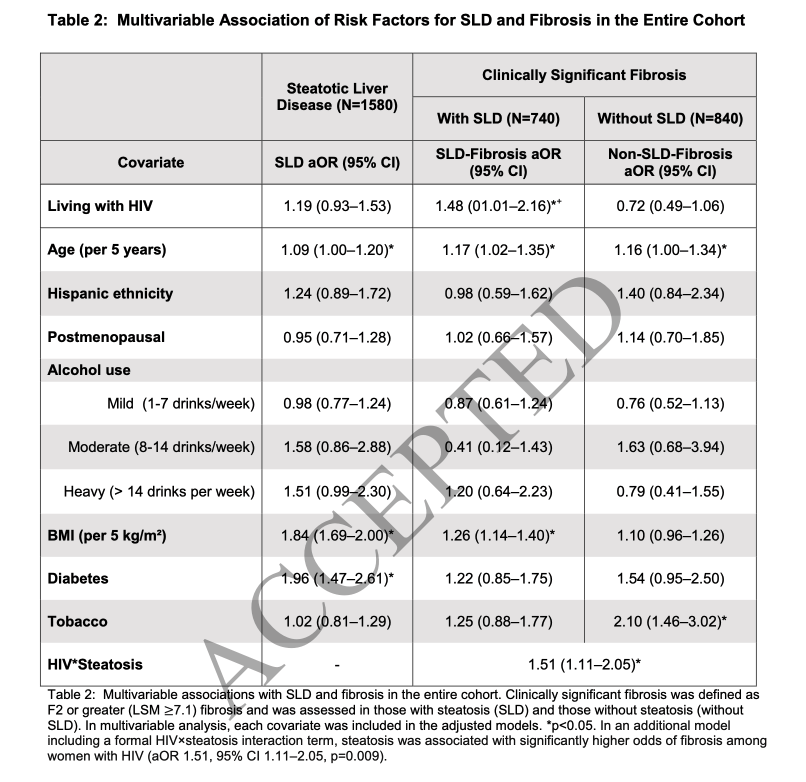
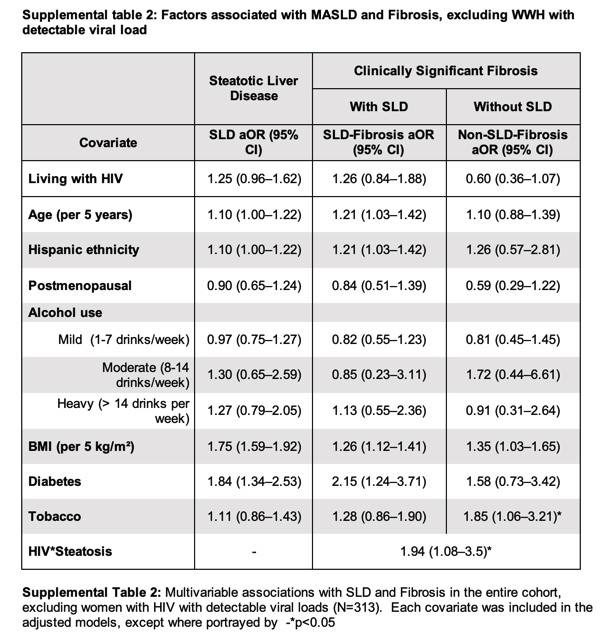
We found amongst women with SLD those with HIV had a higher proportion of clinically significant fibrosis than those without HIV. Notably, significant rates of non-SLD fibrosis were present in both WWH and WWWOH, and about half of these cases were associated with current or chronic HCV infection. When we performed multivariate regression excluding current or resolved viral hepatitis, we found that HIV infection remained significantly associated with an increased odds of fibrosis only in women with steatosis. In our analyses, adjustment for race did not materially change the results, and race was not independently associated with fibrosis or MASLD.
our sub-cohort and analysis was not designed to evaluate drug-specific effects and further studies are needed to
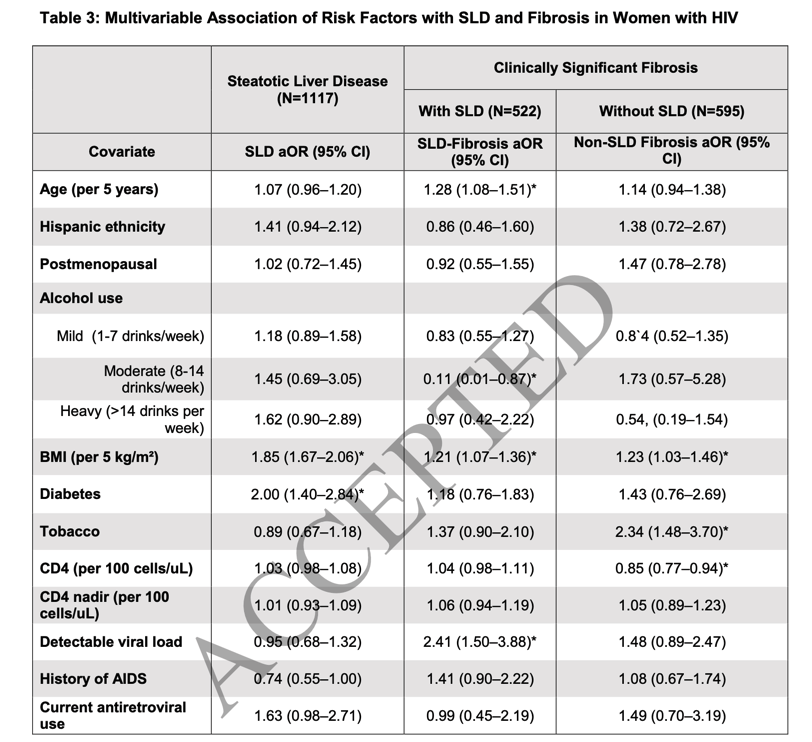
better define the impact of individual antiretroviral agents on steatosis and fibrosis risk. Moreso, widespread use of tenofovir alafenamide (TAF) did not occur until more than midway through the collection of data for this study, which further limits our ability to comment on this drug….. findings suggest that incomplete viral suppression may contribute to the observed association between HIV and fibrosis in the presence of steatosis.
Introduction:
Steatotic liver disease (SLD) is highly prevalent in people with HIV (PWH) and is a major cause of morbidity and mortality in this population. However, it remains unclear whether SLD is influenced by HIV infection and whether the clinical management of PWH who have SLD should differ from non-HIV populations.
Methods:
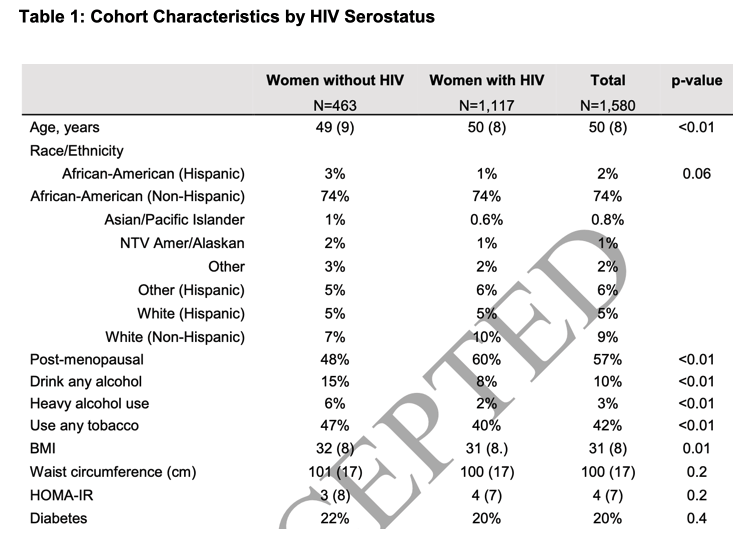
Liver steatosis and fibrosis were assessed using vibration-controlled transient elastography (VCTE) among 1,580 women (1,117 with HIV; 463 without) enrolled in the Women’s Interagency HIV Study between 2013 and 2018. Steatosis was defined by a controlled attenuation parameter (CAP) ≥248 dB/m, and clinically significant fibrosis by liver stiffness ≥7.1 kPa. Participants were classified according to the AASLD diagnostic algorithm for SLD. Differences in fibrosis prevalence by HIV status were evaluated, and multivariable logistic regression was performed to identify factors associated with SLD and fibrosis, adjusting for age, ethnicity, BMI, alcohol use, diabetes, and smoking.
Results:
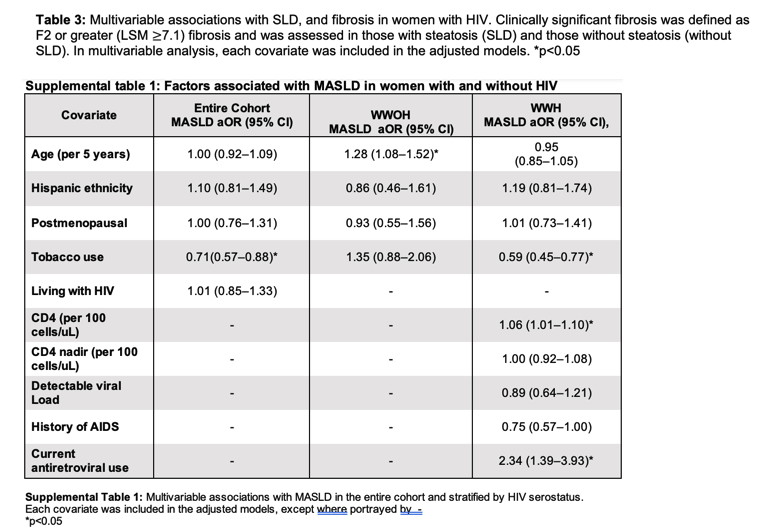
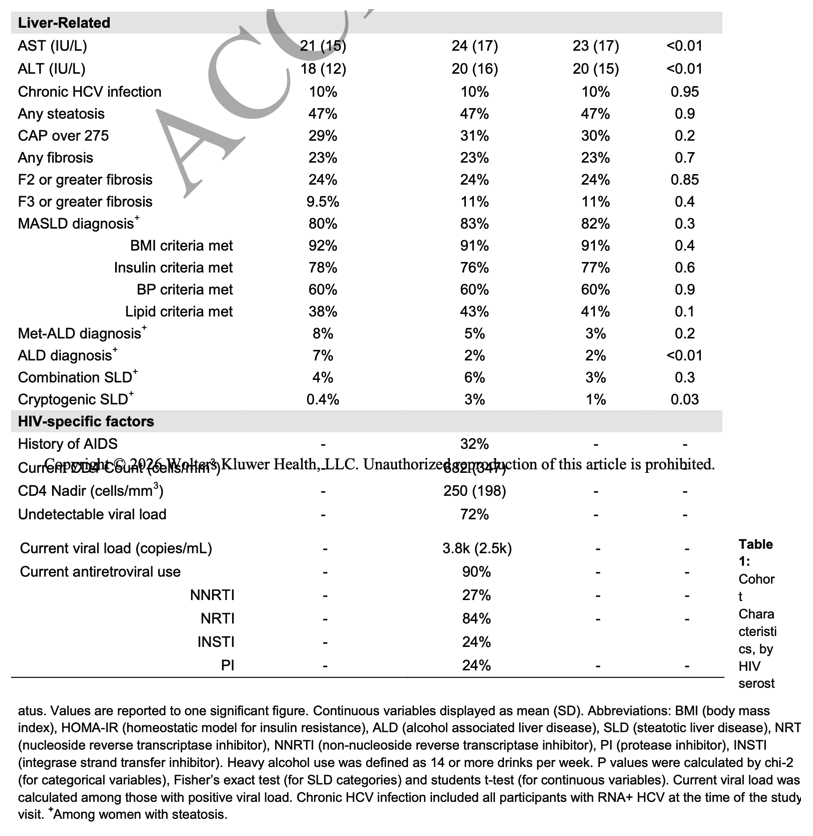
Prevalence of SLD was 740 of 1580 (47%) and did not differ by HIV serostatus. Most SLD was metabolic dysfunction-associated steatotic liver disease (MASLD; 629 of 740 [82%]). HIV infection was associated with higher odds of clinically significant fibrosis only among women with SLD (adjusted OR 1.48, 95% CI 1.01–2.16, p=0.04; HIV*SLD interaction among entire cohort p=0.03).
Discussion:
In this study, most SLD in women living with HIV is classified as MASLD. HIV infection is associated with higher odds of hepatic fibrosis only among those with SLD. Further work is needed to understand how HIV may potentiate fibrosis in the setting of SLD.
| |
| |
| |
|
|
|


