| |
Real-World Experience of Hepatitis C Treatment With Glecaprevir-Pibrentasvir During Pregnancy; Commentary: Treatment of Hepatitis C During Pregnancy: We Are Approaching a "Tipping Point"
|
| |
| |
15 September 2026
Download the PDF
Download the PDF
Hepatitis C virus (HCV) guidelines published by the Infectious Diseases Society of America (IDSA) and the American Association for the Study of Liver Diseases (AASLD) state that direct-acting antivirals (DAAs) may be considered during pregnancy through shared decision making [1].
the annual rate of acute HCV tripled in the United States from 2008 to 2018, fueled by substance use [6]. HCV in pregnancy is associated with adverse obstetric outcomes, including perinatal transmission (estimated at 8%) [7], ICP, preterm birth, and neonatal death [8]. HCV also affects obstetric delivery management. the current paradigm of referral for postpartum treatment has been a failure, with <6% of Medicaid recipients with opioid use disorder receiving DAAs by 6 months post partum [10].
Abstract
Guidelines endorse antenatal hepatitis C virus treatment following shared decision making. No clinical trial or real-world data exist for glecaprevir-pibrentasvir (GLE/PIB). We report our experience with prenatal GLE/PIB in 14 patients. Ten patients completed treatment; all achieved virologic response by or at delivery, with no maternal or neonatal safety concerns.
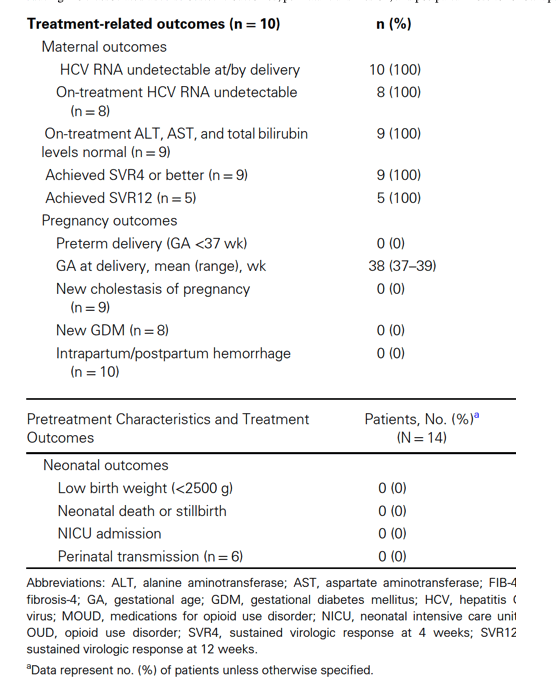
Outcomes in the 10 patients who completed therapy are also listed in Table 1. All patients had an undetectable viral load by delivery. On-treatment liver function test results were available in 8 of 10 individuals with no AST, ALT, or total bilirubin elevations observed. One patient experienced nausea managed with oral antiemetics; the remaining patients who completed the course had no reported adverse effects documented. SVR data were available in 9 of 10 individuals, with all achieving SVR4 or better. The 10th individual had undetectable HCV RNA during treatment prior to delivery but did not present for follow-up SVR laboratory testing. There were no known treatment failures.
No patients were reported to have developed new ICP or GDM or experienced obstetric hemorrhage after initiation of GLE/PIB. In 1 patient with preexisting AST and ALT elevations these values normalized on treatment. It is unknown whether the patient with ICP improved with therapy. All pregnancies ended with delivery at term, with no reported neonatal safety concerns. Six of the 10 exposed infants had available screening, with no perinatal transmissions observed.
These may be critical facilitators to successful HCV treatment in the relatively limited time span of pregnancy, in which delays risk loss to care, treatment opportunities and obstetric complications, particularly in a population with a high rate of public insurance coverage limited to pregnancy.
These findings are particularly important because the annual rate of acute HCV tripled in the United States from 2008 to 2018, fueled by substance use [6]. In addition to long-term hepatic morbidity, HCV in pregnancy is associated with adverse obstetric outcomes, including perinatal transmission (estimated at 8%) [7], ICP, preterm birth, and neonatal death [8]. HCV also affects obstetric delivery management. Current obstetric guidelines recommend avoiding certain procedures that may be associated with perinatal transmission in viremic pregnancies [9]. Unfortunately, the current paradigm of referral for postpartum treatment has been a failure, with <6% of Medicaid recipients with opioid use disorder receiving DAAs by 6 months post partum [10]. Treatment during pregnancy may mitigate this cycle by reducing HCV-associated adverse obstetric outcomes, perinatal transmission, and postpartum loss to follow-up.
| |
| |
| |
|
|
|


