| |
Weight Gain on Contemporary Integrase Strand Transfer Inhibitors and Tenofovir Alafenamide in Persons With HIV Starting Antiretroviral Therapy in the United States and Canada
|
| |
| |
Journal of Infectious Diseases 29 May 2026
Download the PDF here
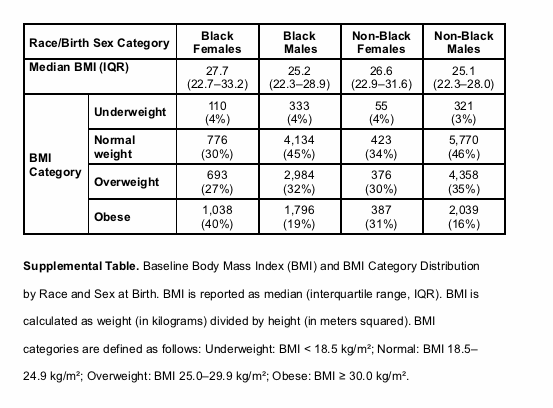
Here, we reassessed weight gain after ART initiation in NA-ACCORD and found that weight gain on non-EFV NNRTI-class medications still appears to be lower than for PI- or INSTI-based regimens, even after limiting NRTI exposure to TDF/FTC alone. Furthermore, our data confirm that Black females are prone to the greatest increase in weight when initiated on TAF/FTC with current first-line INSTIs (DTG and BIC). Black females in our cohort had the highest baseline BMI and obesity prevalence at ART initiation, mirroring national patterns in the United States and Canada. These background differences suggest that the greater weight increases observed among Black women on contemporary ART may reflect an interaction between ART-related effects and broader structural and environmental factors that influence weight in the general population. Furthermore, TAF exposure was associated with a significantly increased risk of >10% weight gain, whereas TDF was not.
Conclusions
This reappraisal of ART-associated weight changes in a large North American cohort highlights significant differences in weight gain between PWH starting NNRTI-based regimens versus INSTI- or PI-based regimens. Notably, even after excluding EFV and restricting the analysis to TDF-containing backbones, NNRTI-based regimens remained associated with significantly lower weight gain. This observation raises important questions about the potential role of other NNRTIs in modulating weight. While evidence for a weight-suppressive effect of RPV remains limited, the lower weight gain observed in the non-EFV NNRTI group in our study merits further exploration. Prospective studies and pharmacologic analyses are needed to clarify whether NNRTIs other than EFV may attenuate weight gain and to elucidate the biological mechanisms underlying ART-associated weight changes.
Abstract
Background
Weight gain is common following antiretroviral therapy (ART) initiation. Integrase strand transfer inhibitors (INSTIs) and tenofovir alafenamide (TAF) have been associated with greater weight gain, though prior analyses may have been confounded by the weight-suppressive effects of efavirenz (EFV) and tenofovir disoproxil fumarate (TDF).
Methods
Treatment-naive adults in the North American AIDS Cohort Collaboration on Research and Design initiating ART between 2007 and 2021 were analyzed. Predicted weight change was modeled using linear mixed effects models adjusted for demographic and clinical factors, and nucleoside reverse transcriptase inhibitor (NRTI) backbone, with subanalyses excluding EFV and stratifying by INSTI agent, NRTI, sex, and race.
Results
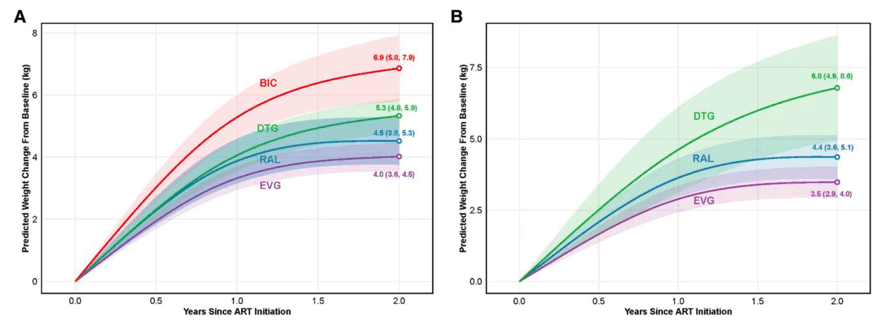
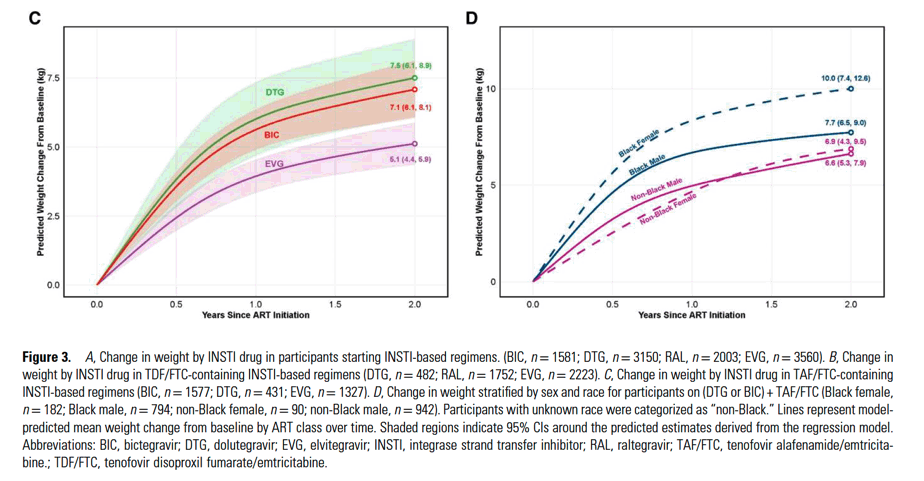
A total of 32 514 persons were included. At 2 years, INSTIs (4.9 kg, 95% CI: 4.6-5.2) and protease inhibitors (PIs) (4.7 kg, 95% CI: 4.4-5.1) were associated with greater mean predicted weight gain compared to non-nucleoside reverse transcriptase inhibitors (NNRTIs) (2.7 kg, 95% CI: 2.4-2.9). Differences persisted when limiting analyses to TDF-containing regimens and excluding EFV. Among INSTIs, mean predicted weight gain was numerically highest with bictegravir (6.9 kg, 95% CI: 5.8-7.9), followed by dolutegravir (5.3 kg, 95% CI: 4.8-5.9), raltegravir (4.5 kg, 95% CI: 3.8-5.3), and elvitegravir (4.0 kg, 95% CI: 3.6-4.5). Participants receiving TAF with INSTIs gained more than those on TDF. Black females on bictegravir or dolutegravir with TAF had the highest gain at 2 years (10.0 kg, 95% CI: 7.4-12.6)
Conclusions
Weight gain with non-EFV NNRTIs was lower than with PIs and INSTIs, with the greatest increases observed among Black females starting TAF with contemporary INSTIs.
|
|
| |
| |
|
|
|


