| |
Real-world use and effectiveness of fostemsavir in a US clinical setting: Insights from Trio Health HIV Research Network
|
| |
| |
22 September 2026
Download the PDF here
The success of modern ART has produced fewer cases of MDR HIV in harder-to-treat PWH. The prevalence of PWH with resistance to three or more core ART classes in a Spanish chart review study conducted at five centres was approximately 0.5% among 14 955 screened PWH [9]. Lombardi et al. reported similar results: a declining percentage of resistance and multidrug resistance in Antiviral Response Cohort Analysis, a nationwide Italian cohort. The study found 9% of the cohort had multidrug resistance defined as resistance to 3 or more ARV classes [10]. McClung et al. reported on rates of transmitted drug resistance in the US between 2014 and 2018, with 18.9% of 50 747 people with drug resistance: an increase from previously reported 14.6% in 2006–2014 [11]. In our study, multidrug resistance was found in 20% of individuals viremic at FTR start and 6% of the suppressed, although genotype results were available only in a subset of individuals (63% viremic and 39% suppressed).
Determining susceptibility is difficult, with no reliable genotypic pattern that predicts susceptibility or failure. Additionally, although phenotypic resistance assays exist, clinical outcome data correlating phenotypic susceptibility with specific substitutions and treatment response do not. Therefore, the use of resistance testing without reliable genotypes that predict diminished responses is of limited clinical value.
DISCUSSION
The use of new antiretroviral agents with unique mechanisms of action is an integral component of improvements in HIV therapeutics. Those with virologic failure and genotypic resistance need unique agents to achieve viral suppression. This study provides valuable real-world insights into the use of FTR in a cohort of 77 treatment-experienced individuals with HIV. At the time of FTR initiation, 60% were viremic and 40% suppressed. Significant differences in demographic and clinical baseline characteristics were found between individuals who were viremic at FTR initiation vs. suppressed. A high prevalence of ARV resistance was observed among individuals with available resistance test results, with most PWH having resistance to at least one ARV class (76% viremic vs. 67% suppressed). Multidrug resistance was present (31% viremic vs. 17% suppressed among those with available results). Integrase resistance was less common and only seen in viremic initiators (7%). Viremic initiators frequently started FTR with a completely new optimized background therapy, whereas suppressed initiators often added FTR to existing regimens.
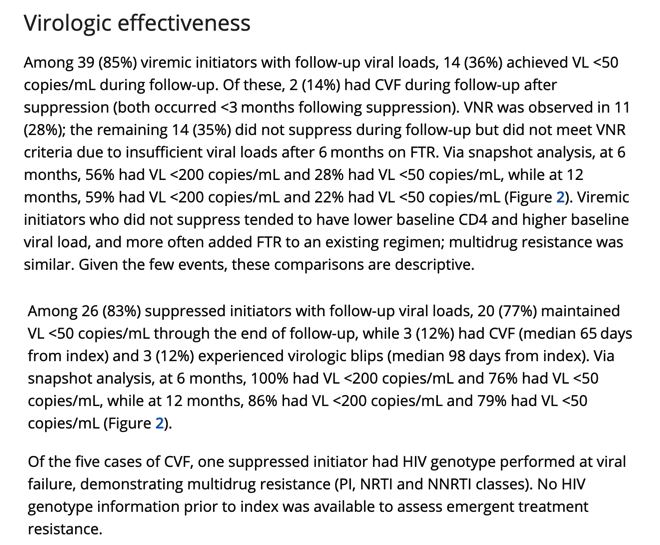
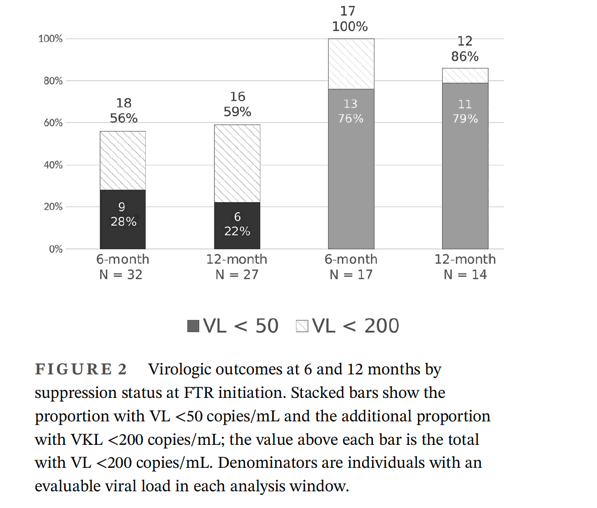
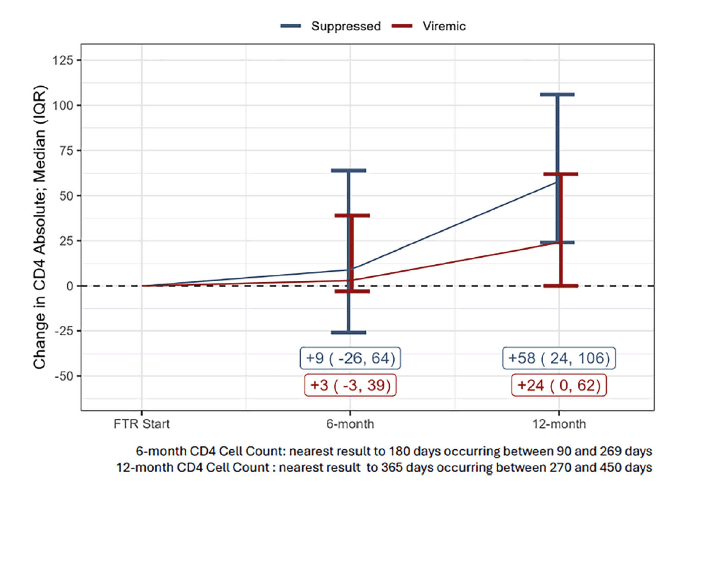
HIV Genotyping prior to FTR was available in 63% of viremic and 39% of suppressed. Most had resistance to at least 1 ARV class (76% viremic vs. 67% suppressed), and MDR was observed in 31% of viremic and 17% of suppressed initiators with genotype results, corresponding to 20% and 6% of all individuals, respectively. Resistance to INSTIs was the least frequently observed and present only in those viremic at initiation (7%).
Most PWH had prior treatment experience with at least 1 INSTI (93% both viremic and suppressed), with 80% viremic and 74% suppressed having an INSTI in their regimen prior to FTR. (Table 2). Only 3/37 (8%) of viremic and 2/23 (13%) changed their INSTI agent when adding FTR. (Table 2).
--
|
|
| |
| |
|
|
|


