| |
Comparing Structural Determinants, Psychosocial Factors, and Individual-Level Risk Indicators for Women's HIV Prevention in the Urban South
|
| |
| |
JAIDS October 08, 2026.
Download the PDF here
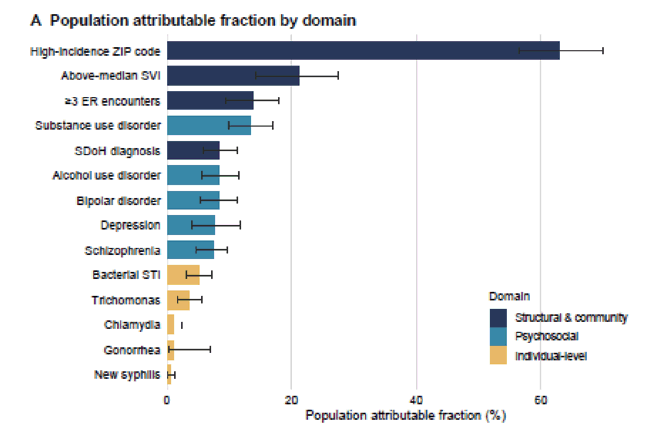
.....This supports our findings that structural determinants, psychosocial factors, and individual-level indicators operate along a gradient of population-level impact.....multiple syndemic factors, particularly financial insecurity, as a prominent theme underlying risk-taking pathways 11,46-48, paralleling our findings that housing insecurity and SVI were among the strongest determinants.....suggesting that HIV risk begins at the structural level and cascades to community, social, and individual levels, with downstream effects compounding structural vulnerability using a positive feedback loop....For example, housing instability and food insecurity have been linked to survival or transactional sex48, which worsen structural vulnerability.
Black women bear a disproportionate burden, comprising 50% of new HIV diagnoses among women in 2022, despite representing only 13% of the U.S. female population21. Since Black women in the South carry the highest HIV burden nationally, this group is crucial for national HIV prevention efforts.. Despite this burden, current risk screening and assessment approaches are not well-suited to identify women prior to HIV acquisition......HIV frequently occurs among women without clinically identifiable individual risk indicators, not because they are absent, but because the tools designed to detect them are insufficient9.......HIV vulnerability in women is also shaped by community-level and structural determinants such as neighborhood-level deprivation, limited healthcare access, and medical mistrust10-13. These social determinants of health (SDoH) may amplify individual-level risk factors, making individuals more susceptible or independently contribute to vulnerability.
Current U.S. PrEP guidelines emphasize offering PrEP in response to self-reported sexual and substance use behaviors and diagnosis of a bacterial STI, yet many women who acquire HIV are not identified through these criteria 9
DISCUSSION
In this ten-year retrospective cohort study of over 333,000 women in Atlanta, structural and community-level barriers were disproportionately concentrated among women who acquired HIV and accounted for the largest share of population-level HIV risk. Nearly half of the women diagnosed with HIV had an above-median Social Vulnerability Index, and more than 80% lived
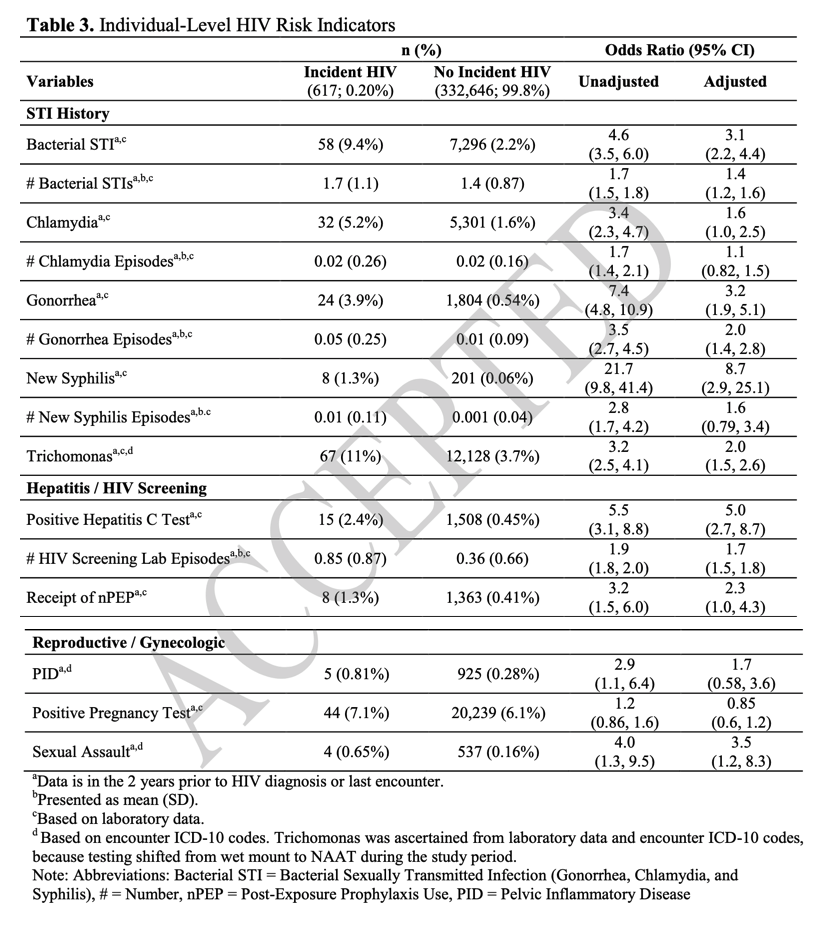
in a high HIV incidence zip code, compared with fewer than 10% who had a bacterial STI before diagnosis. Multivariable regression confirmed that structural determinants were more strongly associated with HIV risk than most individual-level risk indicators, and population attributable fractions showed that high HIV incidence residence and high SVI explained the greatest share of population-level risk. By comparison, psychosocial factors such as substance use disorder and
Background:
Cisgender women, particularly Black women in the Southeastern U.S., experience substantial HIV risk. While current prevention strategies emphasize individual-level risk indicators, understanding the relative contributions of structural determinants and psychosocial factors is essential. This study aimed to evaluate the effects of structural determinants, psychosocial factors, and individual indicators on HIV risk among women in a high-incidence U.S. region.
Methods:
Retrospective cohort of adults assigned female at birth, with ≥1 encounter at Grady Health, a safety-net system serving two of Atlanta's Ending the HIV Epidemic counties (2012-2022). New HIV diagnoses were identified using state surveillance. Logistic regression estimated associations between structural, psychosocial and individual-level indicators and HIV. Population attributable fractions (PAFs) were derived from multivariable models.
Results:
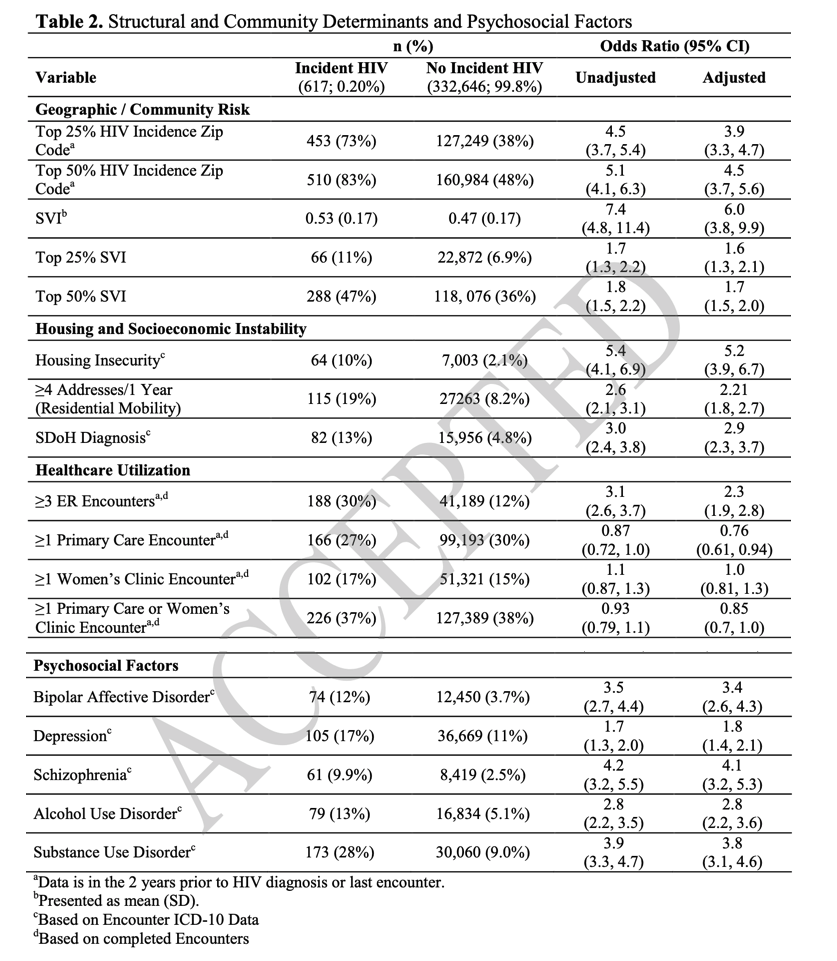
Of 333,263 women, 617 (0.19%) acquired HIV; 88% were Black, mean age was 41. Structural determinants were common and strongly associated with HIV, specifically above-median SVI (aOR=1.7 [1.5-2.0]) and housing insecurity (5.2 [3.9-6.7]). Psychosocial factors such as substance use disorder (3.8 [3.1-4.6]) and individual-level indicators like STIs [3.1 [2.2-4.4]) were also associated. PAF analyses indicated that structural determinants, specifically residence in high-prevalence HIV zip codes (PAF=63% [57%-70%]) and above-median SVI (21% [14%-27%]), accounted for a larger share of population-level HIV risk than individual-level indicators like STIs (5% [3%-7%]).
Psychosocial Factors
Mental health diagnoses were more common among PWH compared to PwoH (Table 3).
Structural determinants
Among PWH, 47% had an SVI above the median, and 11% were in the highest SVI quartile, compared to 36% and 6.9% of PWoH, respectively. Both living in a high HIV incidence zip code and having an SVI above the median were strongly associated with HIV (aOR=4.5 [3.7-5.6] and aOR=1.7 [1.5-2.0], respectively).
Conclusion:
Structural determinants were more strongly associated with HIV and explained a greater share of population-level risk than individual-level indicators. Integrating community context into risk tools may better identify PrEP candidates and support prevention in high-incidence settings.
|
|
| |
| |
|
|
|


