| |
Early patient-reported outcomes and planned persistence with lenacapavir for HIV preexposure prophylaxis in routine clinical care
|
| |
| |
Dec 2026
Download the PDF here
This multicenter study evaluated early patient-reported outcomes (PROs) among individuals initiating twice-yearly lenacapavir (LEN) for HIV preexposure prophylaxis (PrEP) in routine care. Convenience, driven by reduced dosing frequency, was the primary motivation for LEN initiation, and overall satisfaction was high despite frequent but generally mild injection-site reactions. Persistent nodules and pain emerged as the leading patient-reported concerns regarding future continuation, highlighting the importance of patient-centered counseling and implementation strategies to optimize long-term persistence with long-acting PrEP.
Among 96 individuals initiating LEN across four sites, 58 completed the survey (response rate 60.4%). Reduced dosing frequency was the most commonly cited reason for initiating LEN (82.8%), followed by difficulty remembering daily oral PrEP (32.8%). Most respondents (91.4%) reported receiving counseling regarding potential drug–drug interactions before initiation, and self-reported adherence to oral loading doses was high (98.2%).
Forty-five participants (77.5%) reported at least one ISR, most commonly pain (57.8%), swelling (44.4%), and nodules (37.8%). Despite their frequency, ISRs were generally well tolerated. Nearly two-thirds of participants (63.7%) described little or no interference with daily activities after their first injection visit, while six participants (10.3%) reported that ISRs bothered them “to a great extent.” Overall satisfaction remained high, with 79.3% reporting greater satisfaction with LEN than with their previous PrEP regimen.
Since initiating LEN, 29 participants (50.0%) reported taking at least one concomitant medication or recreational substance, these included phosphodiesterase-5 (PDE-5) inhibitors (29.3%), other prescription medications (24.1%), and recreational substances (3.4%). Among those reporting concomitant medication or substance use, nine (31.0%) perceived a change in medication effects after starting LEN; all involved PDE-5 inhibitors.
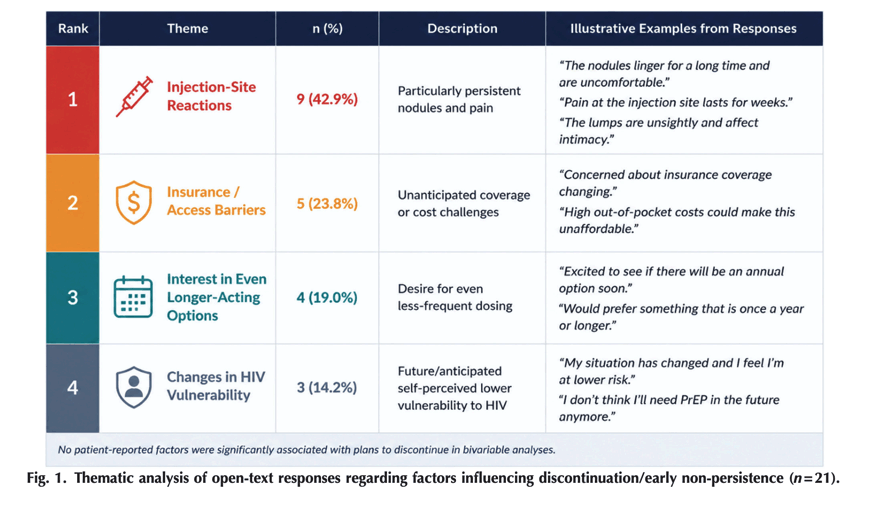
Although satisfaction was high, seven participants (12.1%) reported that they did not plan to continue subsequent LEN injections and an additional two (3.4%) were unsure. No quantitative patient-reported factors were associated with anticipated discontinuation. Twenty-one participants provided open-text responses regarding factors that might influence future discontinuation (Fig. 1). ISRs were the most frequently identified theme (42.9%), particularly persistent nodules and pain. Several respondents described persistent nodules as cosmetically bothersome or affecting intimacy, suggesting that patient experience extends beyond traditional clinical measures of ISR severity. Additional themes included insurance or access barriers, interest in future PrEP options requiring even less frequent dosing, medication interactions, and anticipated reductions in perceived HIV vulnerability.
The frequency of ISRs observed in this study was comparable to that reported in the PURPOSE studies, where ISRs occurred in approximately 69–86% of LEN recipients but rarely resulted in discontinuation . Our findings therefore do not suggest that ISRs are more frequent in routine care. Rather, they provide complementary insight into how patients experience these reactions and which aspects of ISRs may influence willingness to continue therapy . Persistent nodules and pain emerged as the principal concerns despite generally favorable overall satisfaction.
Importantly, anticipated discontinuation should be interpreted in the right context. Participants completed surveys shortly after their initial injection, and intentions may evolve with subsequent injections, counseling, or changing HIV prevention needs. Nonetheless, identifying concerns early in implementation may help clinicians proactively address patient expectations, optimize injection techniques, and counsel regarding the expected course of ISRs. This study has several limitations, including its modest sample size, moderate response rate, potential response bias, short follow-up, and descriptive design. In addition, the participating clinics were large community-based PrEP programs and do not represent all implementation settings.
Nevertheless, these findings represent some of the earliest multicenter real-world PRO data following FDA approval of LEN for PrEP. Although overall satisfaction was high and ISRs were generally mild, persistent nodules and pain emerged as the leading patient-reported concerns regarding future continuation. Longitudinal studies linking early patient experience with observed persistence will be important to determine whether these concerns translate into treatment discontinuation and to inform patient-centered implementation of long-acting PrEP.
|
|
| |
| |
|
|
|


