| |
Comorbidity burden and outcomes with long-acting cabotegravir plus rilpivirine in the RELATIVITY cohort
|
| |
| |
Dec 2026
Download the PDF here
Download the PDF here
Multimorbidity does not necessarily imply poorer adherence, but it commonly coexists with polypharmacy, drug-drug interactions, neuropsychiatric disease, competing appointments, and barriers to treatment continuity, all of which may influence adherence and persistence in both oral and long-acting ART models . These factors could plausibly affect a clinic-based injectable strategy that requires scheduled attendance. They also fit the broader aging-HIV framework, in which comorbidity clustering, inflammation, frailty, and geriatric complexity require individualized treatment decisions rather than exclusion based on age or comorbidity count alone. The present findings extend the efficacy evidence from selected CAB+RPV LA trials and are consistent with implementation-focused literature emphasizing that long-acting ART changes the adherence task rather than eliminating adherence requirements.
In RELATIVITY, among 3118 virologically suppressed people with HIV switching to long-acting cabotegravir plus rilpivirine, 40.0% had at least one comorbidity and 16.8% had multimorbidity. Higher comorbidity burden identified older, clinically complex participants with longer ART exposure, lower CD4 nadir, and more prior AIDS. Virological failure (0.6-0.8%), definitive discontinuation (4.3-6.3%), and complete injection coverage, defined as proportion of days covered (PDC) of 100% (83.4-87.2%) were similar across strata, suggesting that comorbidity burden alone should not preclude individualized use in routine care.
People with HIV (PWH) are aging, and HIV care increasingly resembles chronic disease management . As survival improves, non-AIDS comorbidities accumulate earlier and cluster more frequently in PWH than in comparator populations . Cardiovascular and cardiometabolic diseases are major contributors to this burden.
Results
Among the 3118 participants, 1870 (60.0%) had no comorbidities, 725 (23.3%) had one comorbidity, and 523 (16.8%) had multimorbidity (Table 1). The increasing comorbidity burden captured a clear gradient of baseline complexity: median age increased from 41.0 to 57.1 years, prior ART exposure from 8.0 to 15.0 years, and time with viral suppression from 72 to 120 months across the no-comorbidity and multimorbidity groups.
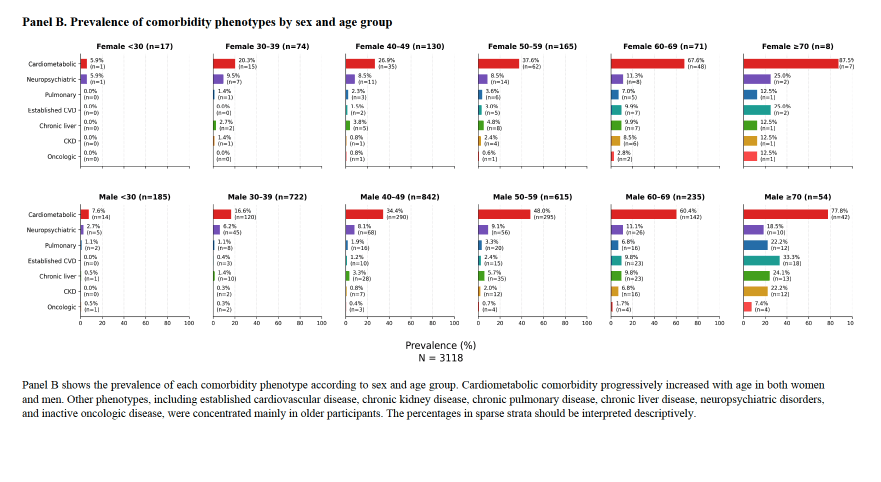
Participants with multimorbidity also had lower CD4 nadir, higher body mass index, more smoking, alcohol use disorder, and higher proportions with prior AIDS and previous virological failure. The cardiometabolic phenotype was the most prevalent and showed the most frequent co-occurrence, particularly with neuropsychiatric and chronic liver phenotypes (Supplementary Figure, https://links.lww.com/QAD/D962). Reasons for switching were largely patient-centered, although toxicity, drug interaction, and swallowing-related reasons were more frequently recorded among participants with comorbidity.
|
|
| |
| |
|
|
|


