 |
|
|
| |
Initial HIV Therapy for Adults and Treatment-Associated
Weight Gain-The Opti-DOR Randomized Clinical Trial
|
| |
| |
July 31, 2026
Download the PDF here
Key Points
Question Among adults with HIV at risk of treatment-associated weight gain, does an alternative first-line regimen produce less weight gain than treatment combinations containing an integrase strand transfer inhibitor (eg, dolutegravir or bictegravir) along with tenofovir alafenamide?
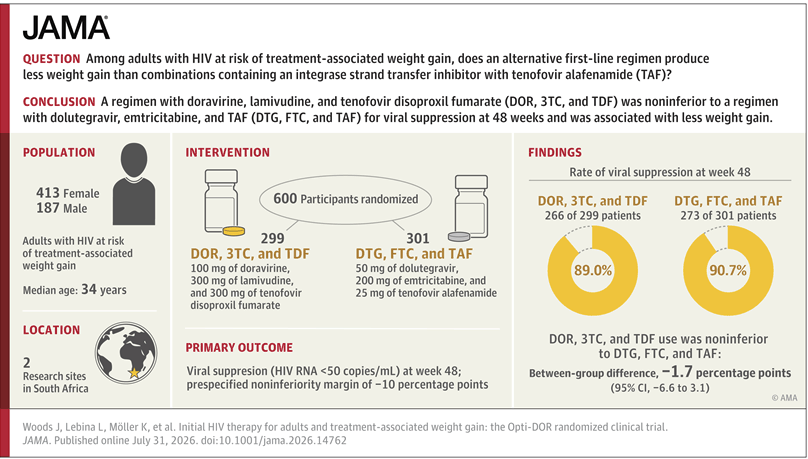
Findings In this noninferiority randomized clinical trial including 600 adults with HIV, initiating a regimen with doravirine, lamivudine, and tenofovir disoproxil fumarate was noninferior to a regimen with dolutegravir, emtricitabine, and tenofovir alafenamide for viral suppression (HIV RNA level <50 copies/mL) at 48 weeks (89.0% vs 90.7%, respectively, meeting the prespecified noninferiority margin of -10 percentage points), and was associated with less weight gain.
Meaning Among adults initiating antiretroviral therapy, a regimen with doravirine, lamivudine, and tenofovir disoproxil fumarate was noninferior to a regimen with dolutegravir, emtricitabine, and tenofovir alafenamide for viral suppression at 48 weeks and was associated with less weight gain.
Abstract
Importance Antiretroviral therapy (ART), particularly regimens containing tenofovir alafenamide with dolutegravir or bictegravir, is associated with substantial weight gain, potentially exacerbating cardiometabolic risk in people with HIV.
Objective To determine whether a regimen with doravirine, lamivudine, and tenofovir disoproxil fumarate results in less weight gain than a regimen with dolutegravir, emtricitabine, and tenofovir alafenamide while maintaining noninferior viral suppression.
Results Among 600 participants, 597 (99.5%) were Black African, 413 (68.8%) were assigned female at birth, and the median age was 34 years (IQR, 28-41). At week 48, 266 participants (89.0%) in the doravirine, lamivudine, and tenofovir disoproxil fumarate group achieved viral suppression (HIV RNA level <50 copies/mL) vs 273 participants (90.7%) in the dolutegravir, emtricitabine, and tenofovir alafenamide group (between-group difference, -1.7 percentage points [95% CI, -6.6 to 3.1], meeting the prespecified noninferiority margin of -10 percentage points).
The median weight gain was 3.0 kg in the doravirine, lamivudine, and tenofovir disoproxil fumarate group vs 5.0 kg in the dolutegravir, emtricitabine, and tenofovir alafenamide group (between-group difference, -2.0 kg [95% CI, -3.0 to -1.0 kg]; P < .001).
Among participants in the doravirine, lamivudine, and tenofovir disoproxil fumarate group, the median change in hip bone mineral density (BMD) was -2.1% (IQR, -4.1% to -0.5%) and was -3.2% (IQR, -5.4% to -0.8%) for spine BMD vs -0.5% (IQR, -1.9% to 1.2%) for hip BMD and -1.3% (IQR, -3.2% to 0.8%) for spine BMD with dolutegravir, emtricitabine, and tenofovir alafenamide (P < .001 for each between-group comparison).
Resistance to doravirine emerged among 7 of 9 participants experiencing virologic failure in the doravirine, lamivudine, and tenofovir disoproxil fumarate group. Of these 7 participants, 5 of 6 achieved viral suppression after switching to dolutegravir-based therapy and 1 was lost to follow-up. Serious adverse events and deaths (n = 2) were infrequent and not considered treatment-related.
Conclusions and Relevance Among predominantly Black African adults initiating ART, a regimen with doravirine, lamivudine, and tenofovir disoproxil fumarate was noninferior to a regimen with dolutegravir, emtricitabine, and tenofovir alafenamide for 48-week viral suppression and was associated with less weight gain.
--
|
| |
|
|
|
|
|

